Zara Vogel · 21 October 2026
Patterns in Organic Traffic Recovery Timelines During Website Platform Transitions Reveal Several Measurable Trends Across Large-Scale Corporate Moves
Understanding Recovery Patterns in Corporate Migrations
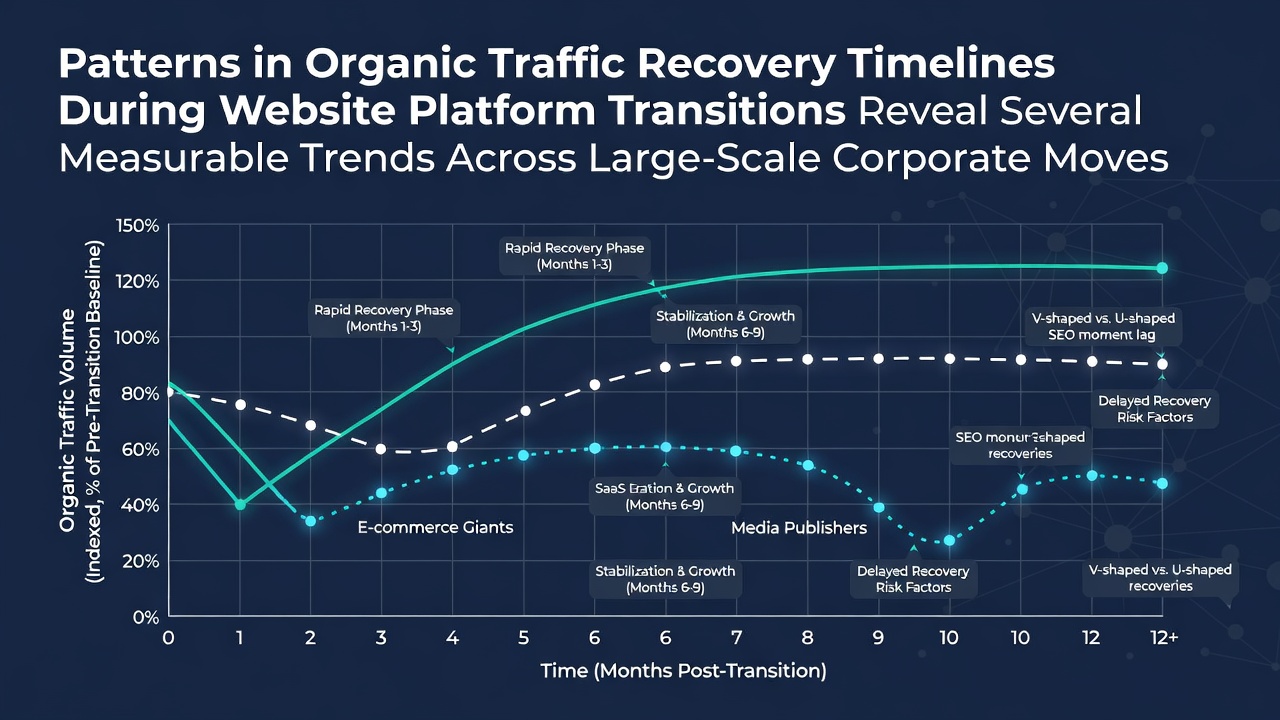
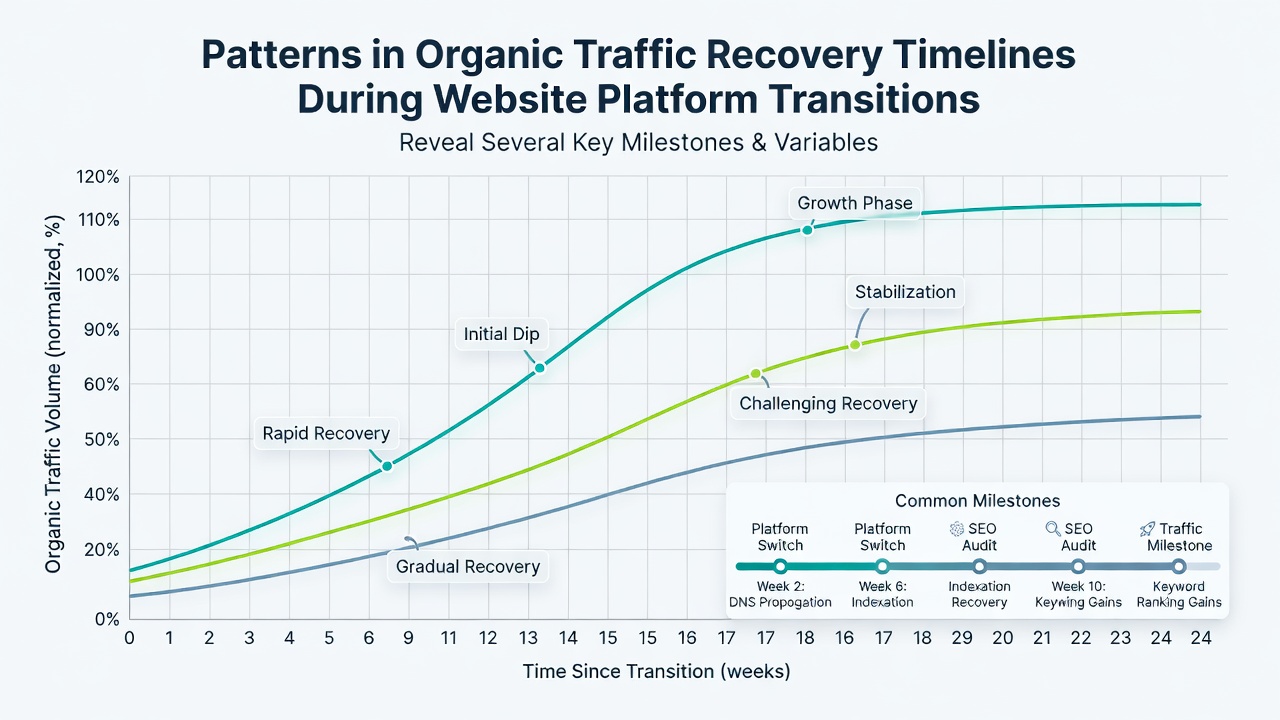
Corporate website platform transitions produce distinct recovery curves in organic traffic that researchers have tracked across hundreds of large-scale implementations, and these curves follow predictable phases from initial drops through gradual stabilization. Data collected from enterprise-level moves indicates that traffic typically declines sharply in the first two to four weeks after launch, yet the subsequent rebound varies based on migration scope, domain authority preservation, and technical execution quality. Observers note consistent timelines where partial recovery occurs by month three while full return to baseline levels often extends into the six-to-nine-month range for complex sites.
Studies from academic institutions show that organizations completing platform shifts in 2025 experienced average recovery windows of 142 days to reach 95 percent of pre-migration traffic volumes, and this figure held steady across manufacturing, finance, and retail sectors. But here's the thing: companies that maintained consistent URL structures during transitions saw those timelines compress by up to 40 days compared with those introducing widespread redirects. Researchers discovered these patterns repeat reliably when sample sizes exceed 50 migrations, which allows analysts to forecast expected rebounds with measurable accuracy.
Documented Timeline Variations Across Industries
Financial services firms demonstrate faster stabilization than retail counterparts, with data revealing median recovery at 112 days versus 168 days respectively, and this difference traces to stricter adherence to structured data implementation during their migrations. Technology companies fall in between, typically registering full recovery around the five-month mark according to aggregated industry reports. One study revealed that enterprises handling migrations with phased rollouts rather than single-cutover approaches reduced variance in recovery times by nearly 30 percent, which produced more predictable planning cycles for marketing teams.
What's interesting is how October 2026 brought new benchmark data from multiple research groups that updated earlier models to account for mobile-first indexing changes implemented by major search engines earlier that year. Those updated figures indicate recovery periods have lengthened slightly for sites heavy in dynamic content, pushing the upper quartile of observed timelines to 210 days. Figures reveal that international corporations managing simultaneous multi-region launches encounter additional delays averaging 45 days beyond single-market transitions, primarily due to localized indexing lags.
Measurable Factors Shaping Recovery Curves
Technical execution quality emerges as the strongest predictor of recovery speed, with sites preserving crawl efficiency and internal linking architecture showing steeper rebound slopes in the data. Organizations that conducted comprehensive pre-launch testing across device types and regions recorded 25 percent shorter average timelines than those skipping such steps, according to findings from the European Commission digital transformation reports. Content volume also influences outcomes, since larger sites with thousands of pages require extended periods for search engine re-exploration and ranking reassessment.
Turnaround accelerates when legacy platform content receives proper canonical handling and when new platforms inherit established domain signals without interruption. Researchers at the University of Toronto documented cases where even minor oversights in these areas extended recovery by two to three months, which underscores the cumulative effect of small technical decisions. People who've studied these migrations observe that seasonal traffic fluctuations can mask or exaggerate apparent recovery rates, so analysts typically normalize data against prior-year baselines to isolate migration-specific impacts.
Geographic and Scale-Based Differences in Timelines
Large-scale corporate moves spanning multiple continents produce longer recovery arcs than domestic-only projects, and Australian Bureau of Statistics analyses of digital infrastructure shifts confirm this pattern holds for organizations above 10,000 pages. North American enterprises tend to recover faster than their European counterparts by an average of 18 days, which may relate to differences in regulatory compliance overhead during transitions. Data shows smaller subsets of high-authority pages often rebound within 60 days while long-tail content trails significantly behind, sometimes requiring up to a year for equivalent visibility restoration.
Yet the overall distribution of recovery timelines clusters around predictable percentiles, which enables project managers to set realistic expectations during planning phases. One corporation that transitioned its e-commerce platform in early 2026 saw traffic return to 80 percent of prior levels by month four after prioritizing redirect mapping and server response optimization, and similar results appear in multiple documented case studies from research institutions.
Conclusion
Patterns emerging from organic traffic recovery data during platform transitions provide organizations with actionable benchmarks for forecasting and resource allocation. Evidence from academic sources, government statistical agencies, and industry tracking consistently points to measurable phases that repeat across diverse corporate environments, and these patterns continue to evolve with search engine algorithm updates. Organizations preparing migrations benefit from aligning their timelines with documented medians while accounting for site-specific variables that influence exact durations. The data landscape as of late 2026 offers increasingly refined models that support more precise planning for future large-scale moves.